TLDR
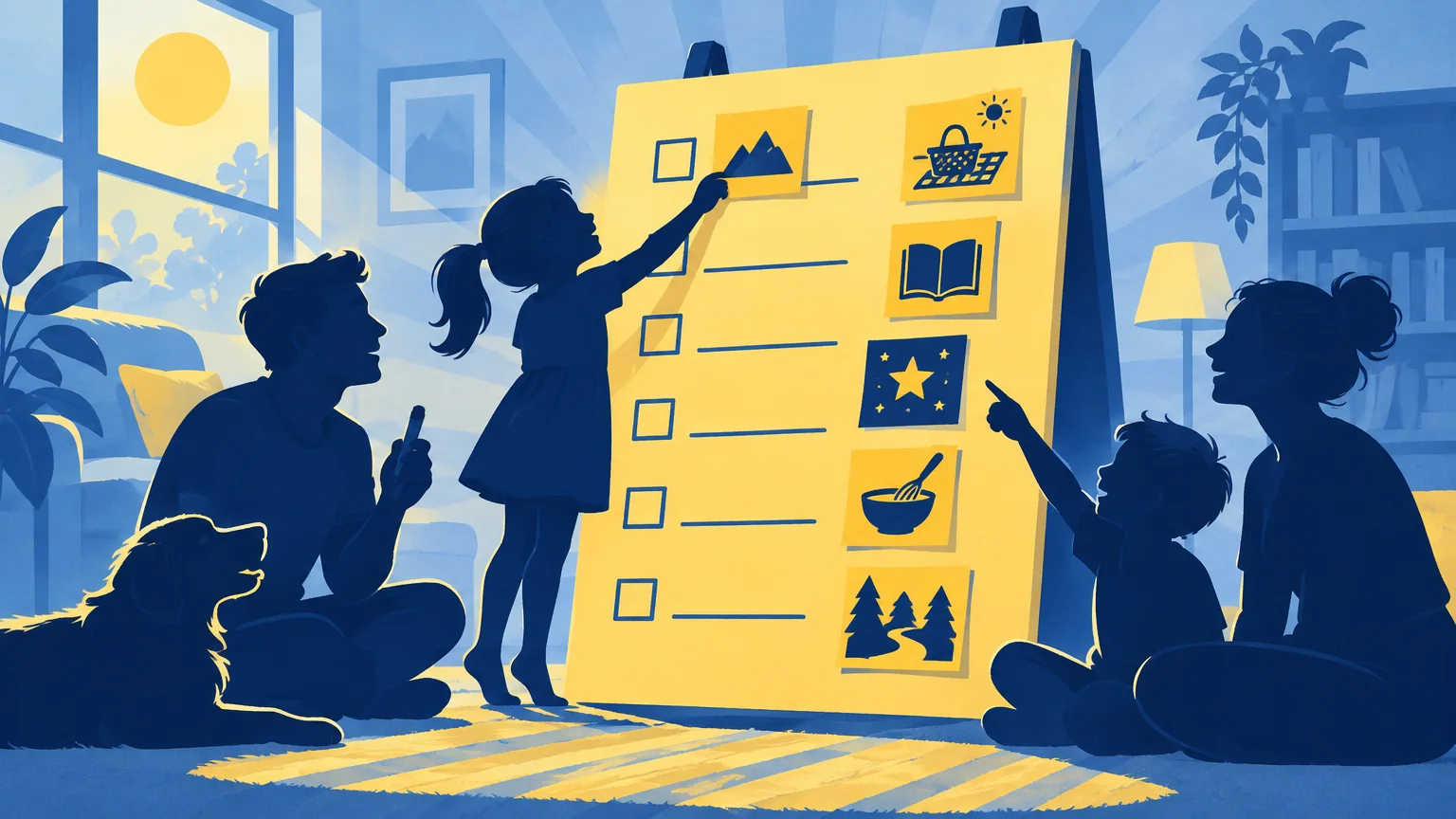
Make a family bucket list printable with a mix of simple prompts and blank spaces. Ask each person to suggest two or three ideas, choose a small number that fit your time and budget, and schedule one at a time. Keep the finished sheet visible, check off activities together and save one tiny memory from each adventure.
A family bucket list printable should feel like an invitation, not an enormous assignment. The most useful version is filled with achievable activities such as making breakfast together, exploring a new park or holding a living-room dance party—not only vacations and costly attractions.
Children are more likely to understand and contribute to the project when they have clear choices. Adults can set practical boundaries around time, cost and safety while leaving room for each child’s interests. That balance reflects the principles in NAEYC’s developmentally appropriate practice guidance, which emphasize meaningful choices supported by thoughtful adult planning.
Set up your family bucket list printable
You do not need a complicated design. Start with one page divided into six cheerful categories: Make, Explore, Learn, Help, Play and Remember. Put two prompt lines and one blank line beneath each category. That creates enough variety for a mixed-age family while keeping the page finishable.
For a homemade version, use a portrait document on US Letter or A4 paper with a title at the top, a short instruction line and 12 to 18 activity spaces. Leave a checkbox of at least half an inch beside each item so small hands can mark it easily. Use high-contrast text, roomy writing lines and icons that support the words rather than relying on color alone.
A hybrid layout usually works better than a completely blank or completely prefilled sheet. Prompts help children get started, while open spaces make the list belong to the family.
| Format | Best for | Possible drawback |
|---|---|---|
| Blank list | Families with plenty of their own ideas | Younger children may need more prompting |
| Prefilled list | A quick start with almost no setup | Some ideas may not fit your budget, location or ages |
| Hybrid list | Most families and mixed-age groups | Requires a short planning conversation before use |
Before printing a PDF, check that the selected printer paper size matches the document size. Adobe explains that page-size choices affect the printed result, so a Letter-size file sent to an A4 setup—or the reverse—may be scaled or clipped. Adobe’s PDF page-size guidance covers the available sizing controls. Print one draft on ordinary paper before using heavier paper or multiple copies.
Build the list in four simple steps
1. Brainstorm without promising everything
Give each person two or three idea slips. Preschoolers can draw an idea or choose between pictures; older children can write their own. Explain that brainstorming collects possibilities and does not guarantee that every idea will happen.
Use practical boundaries such as “under $20,” “within a 30-minute drive” or “something we can do after dinner.” Boundaries make choosing easier and prevent a child from building a list around activities the family cannot reasonably complete.
2. Sort ideas into useful categories
Place each suggestion under Make, Explore, Learn, Help, Play or Remember. If one category is overflowing, invite ideas for a quieter section. A list containing crafts, movement, service, learning and memory-making will be more useful than one filled entirely with outings.
3. Choose a finishable number
For a first attempt, choose six activities for a month or 12 for a season. Mark three as “start here” choices. A short list that gets used is better than a beautiful page of 50 ideas that becomes background decoration.
4. Give the next activity a date
A bucket-list item becomes a plan when somebody decides when it will happen and what it needs. Write a date or week beside the next activity, assign one adult to gather supplies and let a child handle one small job, such as choosing the music or packing napkins.
Easy family bucket list ideas
The strongest ideas are specific enough to start but flexible enough to suit different ages. Use this table as a prompt bank rather than a list you must complete.
| Category | Low-prep idea | Bigger project |
|---|---|---|
| Make | Draw funny family portraits | Build cardboard costumes and hold a parade |
| Explore | Walk a familiar route and find five new details | Visit a park or neighborhood you have not explored |
| Learn | Cook one simple recipe together | Ask a relative to teach the family a skill |
| Help | Collect litter with gloves and adult supervision | Prepare a small donation drive for a chosen local need |
| Play | Create a three-event backyard challenge | Plan a family game tournament |
| Remember | Write one happy moment on a paper slip | Create a photo-and-caption page about the month |
Other low-cost possibilities include eating breakfast for dinner, making a blanket fort, watching the sunset, reading outside, holding a no-recipe snack challenge, visiting the library, learning a card game, writing postcards or creating a family cheer.
Shared recreation, reading, conversation, cultural activities and predictable rituals can all create opportunities for family connection, according to HealthyChildren from the American Academy of Pediatrics. That means an ordinary pancake morning can belong on the list just as comfortably as a special day trip.
A family-photo activity can also become both an event and a keepsake. For example, make the family photo memory-matching game together, play a round and save one set of cards in your memory box.
Adjust the activity for different ages
Preschoolers
Offer two clear choices at a time: “Would you rather have a picnic or make puppets?” Use simple pictures beside the words and keep activities short. An adult should manage tools, travel and safety while the child chooses a color, song, snack or role.
Elementary-age children
Let children write or draw their own suggestions, vote from a shortlist and help collect basic materials. They can also take ownership of one visible job, such as checking the weather, making a supply list or crossing off the completed activity.
Craft-loving children might add a storytelling afternoon using printable paper puppets. The activity can be as small as making one character each and performing a two-minute scene.
Older children and teens
Avoid making the page look babyish. Use a clean checklist or notes-app-inspired design, and invite older children to choose music, plan a route, estimate a small budget or photograph the result. Give everyone a respectful way to pass on an activity and suggest an alternative.
Mixed-age families
Choose projects with several roles. On a picnic day, a younger child can count cups, an older child can help choose the location and an adult can handle food safety and transportation. Not every person must complete the same task for the experience to count as shared.
Use the same idea in a classroom or group
The framework adapts neatly to a classroom, homeschool co-op or after-school group when the goal is specific. Replace family categories with themes such as kindness, reading, nature, creativity and community.
- Kindness list: thank a helper, invite someone into a game or make a card.
- Reading list: read under a table, swap recommendations or act out a scene.
- Nature list: sketch a leaf, listen for three sounds or track the week’s weather.
- Class celebration list: choose a group game, create decorations or plan a shared story.
- School-break list: include indoor, outdoor, quiet and social choices.
For group use, collect suggestions privately before discussing the shortlist. This prevents the loudest voices from deciding everything. The adult can remove unsafe, exclusionary or unrealistic ideas, then let the group vote among workable options. Keep participation flexible so children are not pressured to share family resources, spend money or perform publicly.
Fix the problems that make bucket lists fizzle
The list is too long
Circle three current priorities and move everything else to a “later ideas” page. Completing one small activity restores momentum faster than redesigning the entire list.
The ideas cost too much
Add a cost code beside every activity: free, small cost or save-for-later. Aim for mostly free choices. “Visit the beach” might become “play with water in the yard,” while “go to a show” might become “put on a family talent show.”
Nobody agrees
Give each person one priority pick, then alternate who chooses. You can also combine compatible ideas: a park trip and a drawing activity become a nature-sketching picnic.
The page gets forgotten
Keep it where planning already happens—inside a family binder, on a noticeboard or near the calendar. Add a repeating five-minute check-in to choose the next item. If you display the page within children’s reach, use tape, a clipboard or another secure method rather than small high-powered magnets, which the U.S. Consumer Product Safety Commission identifies as a serious ingestion hazard.
The printout looks wrong
Use print preview and confirm the correct paper size, orientation and scaling. If edges disappear, try the printer’s fit option or return to the source document and increase the margins. If the sheet uses large blocks of background color, make a low-ink copy by removing those fills before printing.
Turn completed activities into memories
Do not let memory keeping become a second giant project. After each activity, save one small thing: a photo, a child’s sentence, a ticket, a tiny drawing or a funny quotation. Write the date and activity on it, then place it in an envelope or folder.
At the end of the month or season, choose one memory to add to a scrapbook page or family display. Children can answer three quick prompts: What did we do? What was funny or surprising? Would we do it again? This keeps the bucket list useful after its boxes have been checked.
Your first-month plan
Start small: make or print one sheet, collect two ideas from each person and select three low-prep activities. Put one on this week’s calendar, choose one for later in the month and keep one as a rainy-day backup. After every activity, save a single photo, drawing or sentence.
That is enough. A good family bucket list is not measured by how dramatic it looks or how quickly every box gets marked. It works when children can contribute, adults can realistically prepare it and the family has a simple reason to spend time doing something together.