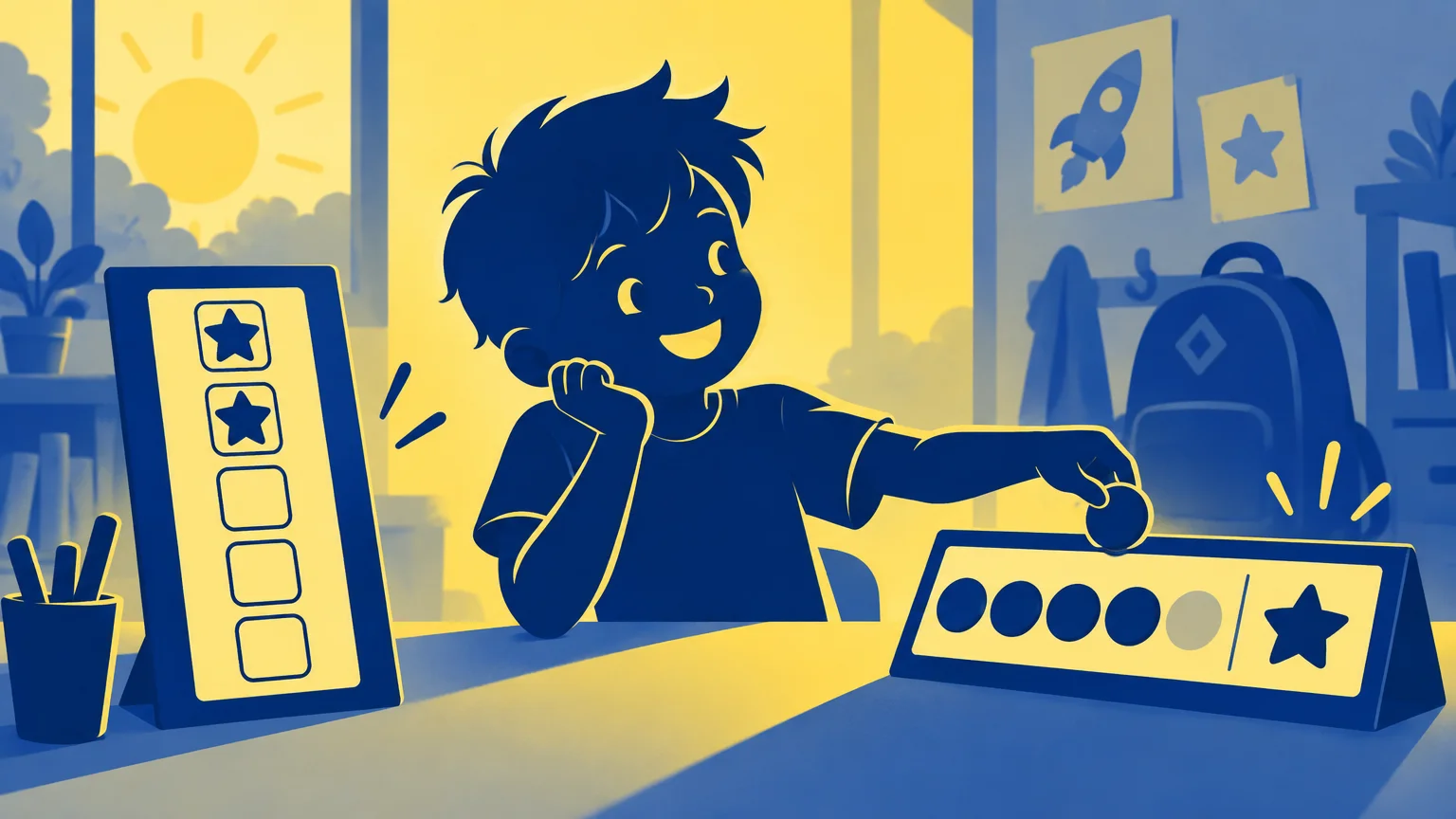
TLDR: For the sticker chart vs token system kids decision, start with the simplest format that matches the goal. Use a sticker chart for one concrete habit that a child can see and repeat, such as hanging up a backpack. Use a token system when a child will benefit from earning exchangeable markers, saving them, or choosing among several rewards.
The key difference is not the marker itself. A sticker can simply record progress on a chart, or it can serve as a token with an exchange value. If five stars can be traded for choosing the family game, you have a token system—even if those tokens happen to be sparkly stickers. A plain sticker chart is easier because it shows progress toward one finish line without requiring a separate reward menu or exchange rules.
Sticker chart vs token system for kids at a glance
| Decision point | Sticker chart | Token system |
|---|---|---|
| Basic format | Markers show progress on a visible chart | Earned markers can be exchanged for selected rewards |
| Best fit | One short, specific routine or skill | Several behaviors, flexible rewards, or saving toward a choice |
| What the child sees | A clear path to one finish line | A balance plus a simple reward menu |
| Adult setup | Low: define the action and finish line | Moderate: define actions, token values, reward costs, and exchange times |
| Useful example | Add one sticker after putting a plate in the sink | Earn tokens for morning steps and exchange them after breakfast |
| Common failure point | The goal feels too vague or too far away | Rules, prices, or exchange times keep changing |
Neither option is automatically better. The best system is the one a child understands and the adults can use consistently. If a five-box chart solves the problem, adding token prices and a reward shop only creates extra work. If one fixed prize does not motivate the child, a small menu of token choices may make the system more useful.
Choose a sticker chart for one small, visible habit
A sticker chart is usually the easier starting point when you can describe the goal as one observable action. “Be responsible” is too fuzzy. “Put your backpack on its hook after school” tells the child exactly what to do and tells the adult exactly when to give the sticker.
For toddlers and preschoolers, keep the visual simple and connect the marker to the action promptly. The CDC recommends specific, age-appropriate behaviors, picture-based charts for younger children, and timely rewards so children can connect what they did with the outcome. Its guidance on praise and rewards for toddlers is a useful starting point for adults working with children ages 2–4.
A simple chart also works beyond preschool. An early-elementary child might use one for placing a folder in the school bag, completing a short reading routine, or clearing a plate. Older children may still like stickers, but the design and privacy matter. A student who enjoys a discreet star on a personal card may dislike a cartoon-filled public chart. For school-age design ideas, see this guide to a classroom reward sticker system for older kids.
Worked example: five-box backpack chart
- Write one goal at the top: “Backpack on the hook after school.”
- Add five large empty boxes in a row. A younger child can follow a picture of a backpack and hook instead of relying only on text.
- Place the chart near the hook, not in a distant room where everyone will forget it.
- Give one sticker promptly after the backpack is hung up, along with specific praise such as, “You put your backpack where it belongs.”
- After the fifth sticker, provide the agreed reward and begin a fresh row if the routine still needs practice.
Five boxes are an easy worked example, not a universal rule. The first finish line should feel reachable for that child. A younger child or a child learning a brand-new routine may need a shorter path, while an older child who already understands the system may manage a longer one.
Choose a token system for flexibility, saving, or several steps
A token system becomes useful when one straight row does not match the task. A child might earn one marker for getting dressed, one for placing pajamas in the hamper, and one for putting breakfast dishes by the sink. Those markers can then be exchanged at a predictable time for one of a few choices.
The American Academy of Pediatrics describes simple paper tokens, including stars, as appropriate for early school-age children, while points and more contract-like formats may suit older children. It also recommends choosing rewards that matter to the individual child, involving the child in those choices when possible, and gradually fading the system as the skill becomes routine.
A token system can help when a child likes making choices or saving toward something, but it adds rules. Adults must decide what earns a token, when tokens can be exchanged, and what each option costs. If those details change from day to day, the system becomes confusing.
Research supports treating token systems as a potentially useful tool rather than a guaranteed solution. A 2023 meta-analysis of preschool classroom token economies found a large overall effect but also identified methodological concerns in the included studies. A 2024 practitioner article likewise emphasizes that implementation quality matters.
Worked example: morning-routine token mat
Create a small mat with three spaces labeled “Get dressed,” “Pajamas in hamper,” and “Breakfast dishes away.” Add a separate box marked “My tokens.” If the entire morning is difficult, begin with only one or two steps rather than putting every possible task on the mat.
Give one token after each completed step. For a reusable home version, the markers might be removable cards; for a disposable paper version, they might be stamps or stickers. If you want durable, child-specific markers for repeated use, custom reward stickers can also serve as tokens when you clearly define their exchange value.
Place a tiny reward menu beside the mat. Keep it manageable: two tokens might buy the choice of breakfast music, while three might buy the choice of tonight’s family game. These are sample values, not prescribed amounts. Set them according to how frequently tokens are available and how soon the child needs a first success.
If the harder problem is remembering the order of morning tasks rather than motivation, a reward system may not be the first tool you need. Start with a flexible kids morning routine chart, then add tokens only if the child benefits from an extra layer of encouragement.
Set up either system so a child can succeed
- Choose one observable action. Replace “listen better” with a direction such as “put crayons in the box when art time ends.”
- Make the first goal reachable. A child should have a realistic chance to experience how earning works before interest disappears.
- Explain the system briefly. Show what the child does, what they earn, and when the reward or exchange happens.
- Give the marker promptly. Pair it with labeled praise that names the action you want repeated.
- Offer a meaningful reward. Ask the child for ideas when appropriate rather than assuming every child wants the same prize.
- Use a predictable exchange time. “After breakfast” is easier to remember than “later.”
- Keep earned progress earned. Do not remove stickers or tokens that the child has already earned.
- Review the system after several uses. Simplify it if adults forget it or the child cannot explain how it works.
- Fade it as the routine becomes established. You might require the marker less often, lengthen the interval gradually, or shift attention toward natural benefits such as finding school supplies quickly.
Rewards do not have to be toys or treats
A reward only needs to matter to the child and be practical for the adult to provide. Choice, attention, and small privileges can be more sustainable than maintaining a prize box. Ask, “Which of these would you enjoy?” instead of building a menu from adult guesses.
- Choose the music during breakfast or cleanup
- Pick the family game or read-aloud book
- Have ten minutes of one-to-one drawing time with an adult
- Choose between two playgrounds or walking routes
- Be the helper who passes out supplies
- Use a special pencil, chair, or classroom job for one activity
- Choose the silly voice used for the bedtime story
- Add one paper link to a family celebration chain
Offer only rewards you can provide reliably. “Choose tonight’s story” is clearer and easier to deliver than a vague promise of a special surprise sometime next week.
Common reasons reward systems stop working
The goal is vague
If two adults cannot agree on whether the behavior happened, the wording is probably too broad. Name an action that can be seen or heard.
The finish line is too distant
A long wait can make the chart feel decorative rather than useful, especially for a young child. Shorten the first round so the child can learn the connection among the action, marker, and outcome.
Too many behaviors are included
A crowded chart asks the child and adult to monitor everything at once. Start with the routine causing the most friction, or with one small step that makes the rest easier.
The reward has lost its appeal
Interests change. Refresh a small portion of the menu or let the child choose among realistic options. Do not respond by making the rules harder without explanation.
Adults are inconsistent
If markers appear only when an adult remembers, the child cannot easily understand the pattern. Move the chart to the point of action, reduce the number of steps, or assign one adult to handle the exchange.
Earned progress becomes a punishment tool
Avoid taking back a previously earned sticker or token after unrelated misbehavior. Both CDC and AAP guidance advise preserving rewards already earned. Address a separate behavior with an appropriate, separate response.
Use private, practical systems in classrooms
A classroom token system does not require a giant public leaderboard. Individual cards, folders, desk trackers, or teacher-held records can preserve privacy and avoid turning improvement into a comparison among children. Keep the earning rule consistent, make exchange options feasible within the school day, and avoid embarrassing designs for older students.
A classwide structure may still use shared language—such as “ready materials” or “quiet transition”—while each child tracks progress privately. If several adults use the system, write down the earning rule and exchange schedule so a token has the same meaning with each adult.
The simplest system is usually the best first step
Choose a sticker chart when you are teaching one short, concrete habit and want the least complicated setup. Choose a token system when saving, reward choices, or several clearly defined actions solve a real organizational problem. Stickers can work in either format; the exchange rules determine which system you have.
Begin with one action, one reachable goal, and one reward the child actually values. If that small system works, resist the urge to turn it into a miniature economy. Add token choices only when the added flexibility helps the child—and when the adults can maintain the rules without making mornings, cleanup, or classroom transitions more complicated.
Reward tools are not equally suitable for every child or every concern. If behavior is persistent, severe, unsafe, or substantially interfering with home or school life, seek individualized guidance from an appropriate pediatric, educational, or behavioral professional rather than relying on a printable chart alone.
References
- Tips for Using Praise and Rewards | Essentials for Parenting Toddlers | CDC
- Positive Reinforcement Through Rewards – HealthyChildren.org
- "The Effect of Token Economies on Student Behavior in the Preschool Cla" by Lynda B. Hayes, Brad A. Dufrene et al.
- Token economies: Evidence‐based recommendations for practitioners – degli Espinosa – 2024 – Behavioral Interventions – Wiley Online Library