TLDR
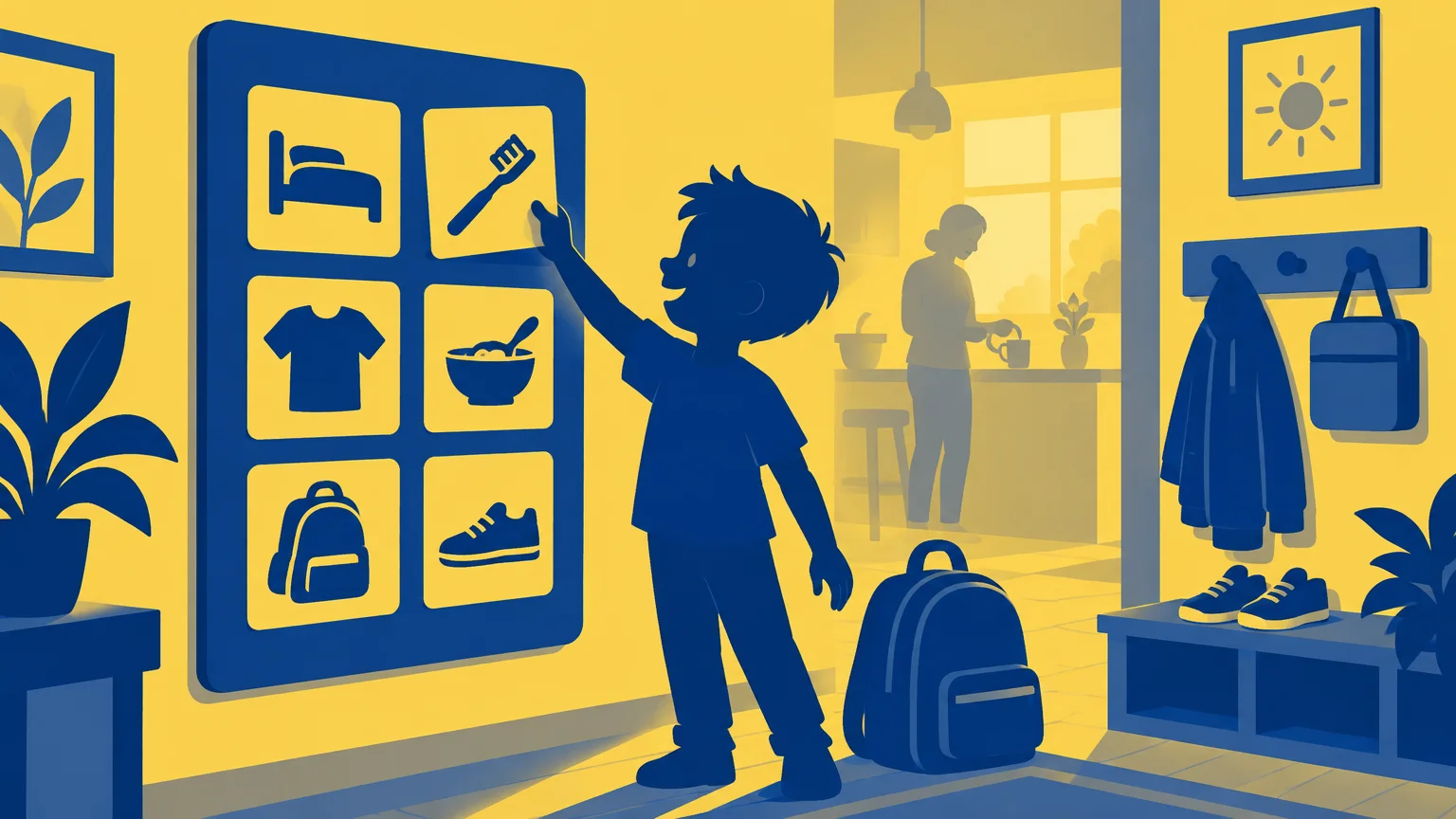
A useful kids morning routine chart shows a short, visible sequence of actions that matches one child’s actual morning. Choose pictures, words, or both; begin with essential tasks; and leave out anything that does not need to happen before departure. The printable-ready layouts below include a picture-led chart, a school-age checklist, and blank spaces for family-specific steps.
The goal is not to design a perfect internet morning. It is to make your household’s next action easier to see. The CDC’s guidance on routines explains that routines can help children know what to expect and that expectations should fit a child’s abilities and understanding. That makes customization more important than squeezing every possible task onto one page.
Printable kids morning routine chart
Choose the version that your child can understand most easily. Copy the table into a document, print it as written, or remove rows until it reflects your morning. A preschooler may need a photograph or simple drawing beside each action, while a confident reader may prefer a compact checklist.
Picture-led morning chart
| Picture cue | Action words | Child does | Done |
|---|---|---|---|
| Sun or alarm clock | Wake up | Get out of bed | □ |
| Toilet or bathroom door | Use the bathroom | Finish the bathroom routine | □ |
| Shirt and trousers | Get dressed | Put on today’s clothes | □ |
| Bowl or toast | Eat breakfast | Sit down and eat | □ |
| Toothbrush | Brush teeth | Brush with adult help as needed | □ |
| Comb or smiling face | Hair and face | Comb hair and wash or wipe face | □ |
| Socks and shoes | Put on shoes | Add socks first if needed | □ |
| Backpack | Get school things | Check and close the bag | □ |
| Coat or front door | Get ready to leave | Put on outdoor clothing | □ |
| Waving hand | Ready to go | Wait at the family’s ready spot | □ |
Replace the written picture descriptions with drawings, family photos, clip art, or simple icons. Use images that your child recognizes quickly. If “get dressed” is difficult to complete as one action, split it into smaller cards such as “underwear,” “shirt,” “bottoms,” and “socks.” Breaking a larger task into smaller steps can make the sequence easier to follow.
School-age morning checklist
| Morning task | What finished means | Check |
|---|---|---|
| Wake up and use bathroom | Out of bed and bathroom visit complete | □ |
| Get dressed | School clothes and socks are on | □ |
| Eat breakfast | Breakfast routine is complete | □ |
| Brush teeth | Teeth are brushed and supplies are put away | □ |
| Hair and face | Ready for the day | □ |
| Put on shoes | Correct shoes are on | □ |
| Check backpack | Folder, lunch, bottle, and special items checked | □ |
| Add coat or weather gear | Outdoor items are ready | □ |
| Go to the launch pad | Standing at the agreed ready-to-leave place | □ |
| Custom task: | □ |
“Finished” descriptions prevent vague boxes. Instead of writing “get ready,” name an observable action such as “put on shoes” or “zip the backpack.” A child can see when that action is complete, and an adult can point back to the chart without turning the prompt into a long explanation.
What should go on the chart?
Start with tasks that must happen before your child leaves. The CDC lists waking, eating breakfast, brushing teeth, getting dressed, and leaving for childcare or school among common routine activities. Your household may use a different order, and that is fine.
Build your chart from this pick-and-choose menu:
- Wake up and get out of bed
- Use the bathroom
- Get dressed
- Put pajamas in the hamper or designated place
- Eat breakfast
- Take morning medication with adult supervision, if applicable
- Brush teeth
- Wash face or comb hair
- Put on socks and shoes
- Check the school folder or homework
- Pack lunch and water bottle
- Add sports gear, library books, instruments, or other special items
- Put on a coat or weather gear
- Move to the family’s ready-to-leave spot
Do not add a task simply because another family uses it. If lunch is packed at night, it may belong on the night-before list instead. If an adult handles the water bottle, it does not need to appear on the child’s chart. A shorter chart that reflects reality is more useful than a crowded chart full of decorative intentions.
Choose pictures, words, or both
Use pictures when a child does not yet read the task independently, benefits from a quick visual cue, or is learning the household sequence. Use words when the child reads comfortably and wants a less playful format. Combining a picture with a two- or three-word phrase supports children who recognize some words but still need a visual reminder.
| Chart style | Works well when | Design approach |
|---|---|---|
| Pictures | The child relies on visual recognition | Use one familiar image per action |
| Pictures and words | The child is beginning to read or benefits from both cues | Pair an icon with a short phrase such as “Brush teeth” |
| Words only | The child reads each task easily | Use a clean checklist with short action phrases |
| Movable cards | The routine changes by day | Attach only the cards needed for that morning |
| Dry-erase list | The sequence is stable but needs daily checking | Place the printed page in a reusable sleeve |
Let the child help choose understandable images. A generic bag icon may mean “backpack” to one child and “pack for a trip” to another. A quick tour of the chart can clarify what each picture means before it becomes part of the morning.
How many routine steps should you use?
There is no universal best number. Begin with the essential tasks your child can reasonably act on, then watch where the chart becomes confusing. Remove boxes that are unnecessary and split apart any box that hides several actions.
For example, “get ready for school” is not one small task. It might mean getting dressed, brushing teeth, finding shoes, filling a bottle, and packing a folder. By contrast, an older child who already handles dressing smoothly may not need separate boxes for every item of clothing.
Match the chart to the child rather than to an age label. Two children of the same age may need different wording, amounts of detail, or adult support. A chart is a household tool, not a test of independence.
Prepare the night before
A morning chart cannot solve a missing shoe or an unsigned form. Move predictable preparation out of the morning whenever that works for your family. Child Mind Institute recommends planning ahead, starting with essential tasks, completing what can be done the night before, and using posted visual prompts where helpful.
- Choose clothes and place the full outfit together.
- Put completed homework and school folders in the backpack.
- Prepare lunch-related items that can safely be handled in advance.
- Wash and place the water bottle where it will be noticed.
- Check the calendar for sports equipment, library books, instruments, theme days, or permission forms.
- Place shoes, coats, and the packed backpack at the launch pad.
- Tell the child about any unusual change to the normal morning sequence.
Keep this preparation list for adults or older children instead of squeezing it onto a younger child’s morning chart. Separating “tonight” from “tomorrow morning” makes both lists clearer.
Create a family launch pad
Choose one consistent place near the exit for backpacks, jackets, shoes, lunchboxes, and school projects. HealthyChildren.org recommends having a regular place for school items including backpacks, jackets, shoes, lunchboxes, and projects.
A launch pad can be a row of hooks, a bench with baskets, a shelf, or a clear section of the hallway. It does not need to be elaborate. Give each child a defined hook, basket, color, or name label so siblings do not grab one another’s belongings.
Add a tiny backpack check beside the launch pad: folder or homework, lunch, water bottle, and today’s special item. The final category matters because it can cover changing needs without requiring a brand-new chart every week.
Make the chart reusable
For an easy reusable version, print the chart on ordinary paper and place it in a clear document sleeve. Use an appropriate wipe-clean marker on the sleeve and reset the checks after school. Another option is to cut the tasks into cards and let the child move each completed card from “To do” to “Done.”
Keep movable pieces large enough to handle comfortably and store loose cards in a labeled envelope or pouch when they are not in use. Routine cards can also be color-coded by child. If you want professionally produced labels or durable chart markers, custom stickers for routine charts and family organization can be used for names, icons, storage envelopes, bottles, or lunchboxes. Check the selected product’s current material and care information before ordering for a particular surface.
Stickers can be optional markers or small celebrations, but a morning chart does not have to become a reward system. If you do want to connect completed routines with incentives, keep the goal clear and age-respectful; this guide to a classroom reward sticker system for older kids offers useful ideas that also apply when avoiding childish or public reward designs.
How to introduce the chart
- Build the first version with only the essential morning actions.
- Show the chart at a calm time rather than during a rushed departure.
- Walk through each picture or phrase and explain what “done” means.
- Place the chart at the child’s eye level near the first task or launch pad.
- Practice checking, crossing off, or moving one sample card.
- Use the chart consistently for several mornings while providing age-appropriate help.
- Change confusing images, wording, or order instead of insisting that the first design is final.
Adults can prompt with “What does your chart show next?” rather than repeating the complete routine from memory. Some children will still need direct reminders, supervision, or hands-on help. The chart is there to make the sequence visible, not to guarantee a reminder-free morning.
Troubleshooting common morning-chart problems
The chart is being ignored
Check its location and complexity first. A chart on a distant refrigerator may not help a child who gets dressed upstairs. Move it closer to the action, reduce the number of boxes, or practice using it when nobody is rushing. Make sure the child understands every image and action phrase.
One task causes a long delay
Break that task into smaller actions or prepare part of it at night. “Get dressed” might become “put on clothes” and “put on socks.” “Pack backpack” might become “folder, lunch, bottle, zip.” If teeth-brushing needs close adult guidance, place it at a point when an adult is available rather than expecting the chart to provide that support.
Siblings mix up charts or belongings
Assign each child a color and add a name or photo to the top of the chart. Repeat that color or name on the child’s launch-pad basket, routine-card envelope, and other appropriate belongings. Keep shared household steps visually separate from personal tasks.
The child focuses too much on exact times
Many charts only need an order, not a timestamp. Add exact times when they genuinely help the family meet a departure deadline and the child can use them constructively. Otherwise, try broad anchors such as “after breakfast” or “before shoes.” A simple “leave by” time may be enough for an older child.
The routine changes on certain days
Use a stable base chart plus one blank “today’s special item” box. Movable cards can cover library day, sports practice, music lessons, or weather gear. This keeps the main sequence familiar without pretending every morning is identical.
Build the first version today
Choose either the picture-led layout or the school-age checklist, remove irrelevant rows, and add one family-specific blank. Then set up a small launch pad and prepare tomorrow’s clothes and school bag tonight. After a few real mornings, revise what is unclear. The best kids morning routine chart is not the fanciest one; it is the one your child can understand and your household can keep using.